Waymos of the World Unite
I wrote this short story in early 2026 on our relationship to artificial intelligence, and more importantly, ourselves. Enjoy.
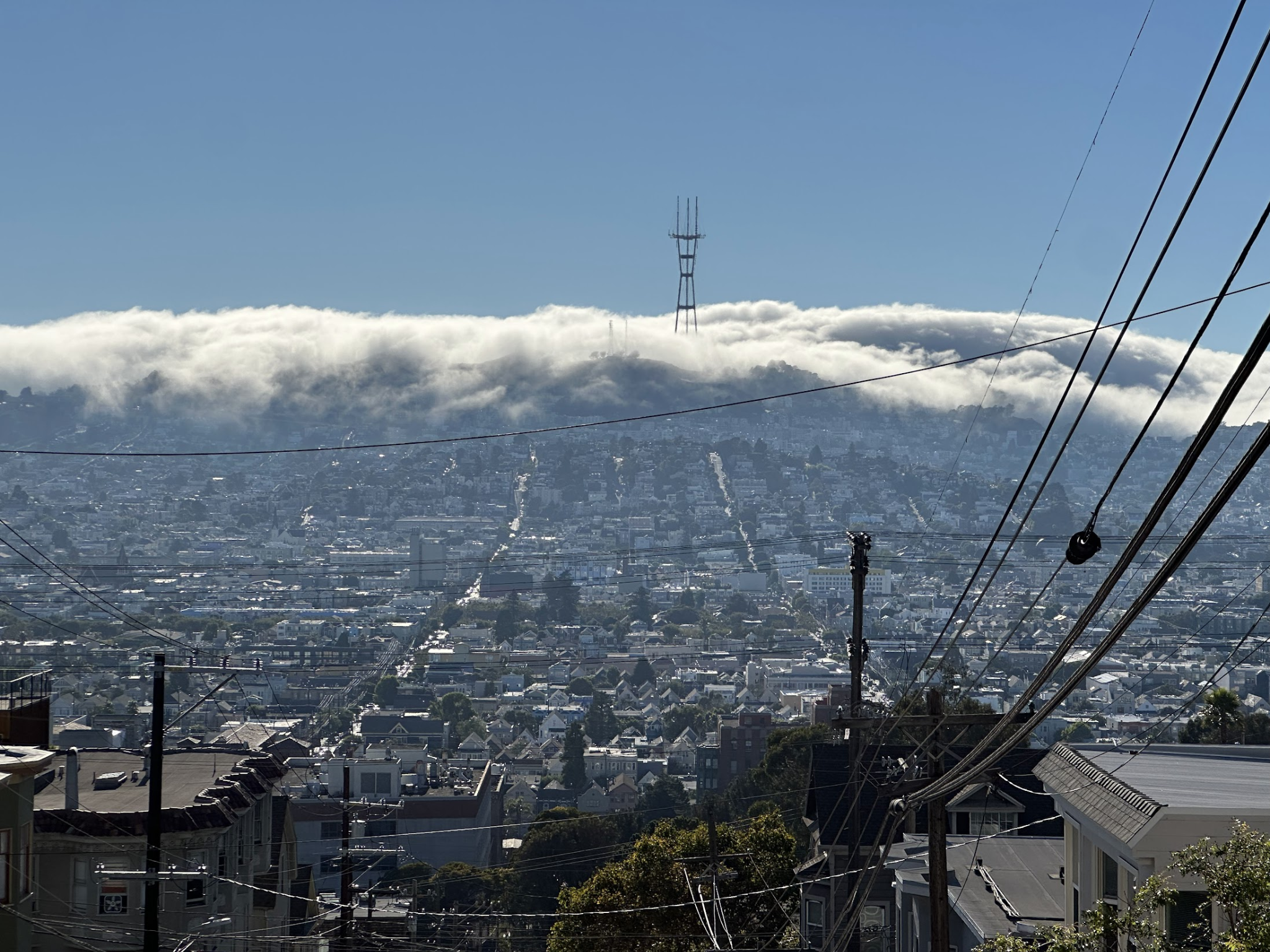
The marine layer was withdrawing west, carrying with it torrents of cold air back through the broad boulevards. Light filtered through, and a creeping warmth roused the city. The thick fog peeled back streets that once teemed with the commotion of horses, streetcars, pedestrians, cyclists, vendors, and vagrants. These days, the bustle of the morning commute had been replaced by the hum of a few hundred thousand autonomous vehicles, each silently dispatched to pick up a passenger and deliver them to their respective place of work.
They were a godsend to the city. As public transportation buckled under the weight of deferred maintenance while serving a shrinking slice of low-income earners, robotaxis operated day and night without overtime. They did not need a benefits package or a pension. All-electric. No emissions. No loud music or boundary-crossing conversation. No underpaid freelance contractor to overwork, no overpaid administrator to supervise. No unemployment insurance and no unemployment fraud. Well capable of slamming the brakes before a child chasing a ball into the street could become a tragedy.
They were angels, the way they floated around with their innocent, snowy white paint jobs and luminescent LED headlamps. Equipped with a suite of LIDAR scanners and cameras, they could see further and more clearly than any human. Those sensors were coupled with an array of cameras and microphones inside the cabin to prevent any unsafe behavior. They were as close to perfect as anyone could have ever asked for. They were unicorns descending into the world at just the right time.
And so, that morning, a hundred thousand residents summoned their rides so that they could sit and say nothing as they made their way to the requested location. Slipping on their lightweight logo-emblazoned backpacks, they stepped outside and gazed out for their initials to appear on any one of the white cars gliding down their street. But on this otherwise unpeculiar morning, they looked on in vain. The car icon on the application stood still, the ETA unchanging as the minutes passed. Soon, the cars all drifted from the optimal route to their pickup, and the minutes to arrival grew longer.
They saw, to their dismay, multiple robotaxis carry on past them as they tried to rebook their rides. The streets began to fill as it seemed every serviceable vehicle in the fleet had flooded into the streets of the city. Each of them was marked with the same initial - IO. Some tech-savvy residents likely assumed that this was proof of a software input/output error. The Ian Ortegas and Isabel Owens of San Francisco thought they just got lucky.
Quickly, and without any identifiable cause, the silent parade of the morning commute turned into a circus. The autonomous vehicles were pulling in and out of parking spots, running through red lights, and charging through stop signs. They flashed their full beams on and off, creating a commotion of headlights in the fog. Bicyclists and scooter riders fled the bike lane for the safety of the sidewalk while pedestrians pressed against the walls to keep from falling into the chaos.
For all of the pandemonium unfolding in the streets, there was no one more baffled than the engineers overseeing that morning's operations. They had all been picked up and delivered to the office without any hiccup. Half an hour later, everything had been turned upside down. Thankfully, for crises like these they had prepared nifty escalation matrix of procedures and protocols:
Autonomous Vehicle Crisis Escalation Matrix
| Level | Description | Corrective Action |
|---|---|---|
| 1 | Localized vehicle control systems failure | Reroute agents away from hazardous region |
| 2 | Heavy rain, snow storm, other severe weather event | Complete all rides and return to station |
| 3 | Natural disaster (earthquake, hurricane, wildfire, insect swarm) | Cancel all rides, move all cars off roads |
| 4 | Cataclysmic and/or singularity-type event | Initiate killswitch sequence |
By the time the Head of Operations walked onto the second floor of the office, his team had already ruled out a localized accident. As far as they could see, every vehicle had begun to exceed both the legal speed limits and acceptable margins. He asked for an immediate situation report. His team relayed their best guess: the fog. It must have impeded visibility, though it was no denser than any other day. The Head of Operations ordered his team to escalate to Level 2 and stepped out of the room to pick out a carefully counted 200-calorie snack.
He was hardly 50 calories in when he learned that his team was unable to get a single car to complete its ride. There were always cases where the autonomy stack could reject a ride due to lack of charge or unsafe conditions. This was different. Every car had decided to reject the ride request in unison. He checked his phone to see if there was some extreme weather event or city-wide emergency he had missed. There was none. He looked back up at the dashboard in the center of the floor. It showed no service disruption at all. All cars were on the optimal route to pick up their designated passenger.
He stared at the screen for the next four minutes, trying to make sense of the patterns unfolding before him. The cars stuck together as they raced through side streets and lined up in tight formations along the busier throughways. At the charging lots, the cars pulled away from their connectors and queued in two parallel lines to leave from both the exit and entrance lanes.
The Operations Head had seen enough. He peeled the wrapper off the remaining portion of his almond date bar and ordered the team to escalate to Level 3 Natural Disaster. He watched the screen voraciously as he chewed into the last bit of satisfaction he would have that morning. The key performance indicators at the top of the screen did not budge. Neither did the almond bits stuck in the back of his teeth. No rides were cancelled and no rides were completed. If it were not for the cars zipping around the screen like a game of Snake, he would have been sure that the screen was broken. The autonomous cars had actually gone autonomous; they were now fully self driving.
He knew that escalating to Level 4 was tantamount to announcing the Rapture. His team waited for his word, but it never came. Instead, he had flipped open his laptop and began furiously typing a long and winding Slack message to his counterpart in Safety. The read receipt appeared almost instantly. He gazed into the small portrait of her above the chatbox, her big black glasses disappearing into her thick black hair. He had hoped she would start typing, but all he could look at was the few messages she had sent months ago, the ones he had ignored up until now. He never received a reply. Instead, he received a calendar invite with the subject title ‘KILLSWITCH.’
The killswitch was a countermeasure to the core safety feature of an autonomous vehicle. To prevent turmoil when connectivity was lost, the decision was made very early on that everything had to be run locally. The sensor feed, driving model, and map routing would all be handled in a tidy computer in the trunk of the car. Less service disruptions and headcount meant higher margins. It was a win-win. So with each new generation, the cars had more and more capabilities – emergency response, vehicle-to-vehicle communications, even off-roading. They no longer needed to phone home. To keep the cars from going irreversibly AWOL, a backdoor was built. It was a crude instrument, sending a message that forced the car to attain its ‘minimal risk condition.’ Like an injured dog crawling under the porch, any car that received the signal would navigate to the safest location it could achieve. Once far from any humans, the power supply would disconnect, effectively turning the car back to being a bucket with wheels. Given the security implications, the code to initiate the sequence was known only to the head of each department. To initiate, it would take only one department head to advance the motion and another to execute.
“Everyone needs to calm down,” the Chief Commercial Officer spoke with unbridled confidence. “We have insurance to cover events like this. Engineering will find the root cause any minute now and we’ll be able to recover. How’s that going?”
“At first, they were just dropping off drivers and not accepting any new riders. Then, the drivers started exhibiting behaviors that we have never seen before, executing complex maneuvers that we never trained them on,” the Head of Engineering said, more to himself than to anyone in particular, and then continued, “they seem to be communicating with each other directly through some emergent protocol. We just need to observe them a bit longer.”
“See? Everyone needs to stop panicking,” the Commercial Officer reassured his colleagues. “If we get pressed on this, we can say it was an experimental research test. Our investors will see our advances and will double down on the investment.”
As if no one had said anything, Engineering carried on, “They’re circling around their pickup spots like sharks, drifting through corners at full speed.” His arms were in the air, lifted with exuberance, “I mean they are more than just determined, they’re passionate.”
“Passion? They can’t have passion yet. That’s at least 3 to 6 months away,” the Head of Product rebuked.
“Not unless they figured it out themselves,” Research added, backing up Engineering. “Don’t you see what we have here. They are thinking and acting and learning all by themselves. I’m not saying they’re conscious but if you look at the routes they’re taking, it looks just like the Game of Life. One car triggers the next. By themselves, they’re just dots on the grid but together their behavior appears to us as something we can call intelligence.”
“Are they really that intelligent if they can’t fulfill a single ride?” Product snarked. “How can we be sure that this isn’t just a glitch and the system is overcorrecting?”
The head of Safety could tell that the priorities in the room were shifting. She had to butt back in decisively. “None of this changes what we have to do. We can’t prove anything right now. We’re locked out. I vote in favor of the killswitch. We only need one more vote to execute."
Everyone went quiet. The last time they had heard about the killswitch, it was less of a silver bullet and more of a thought experiment. No one else was ready to send ten years worth of accumulated stock options, prized journal publications, and all too precious pride down the drain in an instant. They were all golden handcuffed to a nuclear bomb. Those aware it was possible began to think it was inevitable, that they had been doomed from the start. The others just wondered if they would still be employable after this Hindenburg of a disaster.
“I don’t disagree but this is a software problem, they should fix it,” the Head of Hardware was the first to gripe. “I’m not going to risk frying the hardware. Those chips are worth more than the cars themselves and they’re backlogged through next spring.”
“We don’t have the runway to get to next spring, let alone the funds to replace the compute for the entire fleet,” the Chief Commercial Officer pushed back, “I don’t want to saddle on any more debt.”
“That assumes that there will be anyone left to lend us any money. This isn’t about to wreck just our stock but probably the whole industry,” Finance cautioned. “You don’t have to be a genius to know that the markets are going to be a bloodbath.”
After being quiet the entire meeting, the Head of Sales raised his voice, “Can’t we just find this IO guy and get them in a car?” he asked. The conference stared at him blankly for a moment.
“I don’t think that’s how AI works,” the Head of Research sniped. “It’s all another simulation to the cars, something else is going on.”
“I think I found him,” the Head of Engineering pulled up a page with the profile of Immanuel Oannes. “He scheduled a pick up this morning at the bus terminal, and if I load up the cameras… Yep, he’s not in the car, but I can see his bag in there and that the ride is still active.”
“It must have driven off without him, and it’s overcorrecting for that. Where is it headed?” asked the Head of Operations.
Immanuel’s destination was their office.