Power Delayed: Iraq’s Electricity Crisis
With every round of protests, Western news agencies, energy industry analysts, and government officials release a dozen articles, press releases, and interviews on why Iraq continues to fail to provide enough power to its people. They each share the same three explanations. The first is that damage from ‘decades of conflict’ hinders the country’s electrical supply. Between tyrants and terrorists, they reason that Iraq’s war-torn power system has not have an opportunity to be rebuilt. Despite the best efforts of the international coalition partners and their corporate complements, they suggest the infrastructure is too ‘combat-fatigued’ to generate adequate levels of power. The second account these groups provide is that Iraqis’ unconstrained demand for electricity overwhelms the nation’s already meager resources. The narrative purports that the removal of US sanctions flooded urban markets with inexpensive “energy-gobbling” appliances, particularly refrigerators and air conditioners.[1] This frenzy for power is made even worse when Iraqis treat electricity as practically free. Government officials regularly bemoan how “few consumers” pay their bills with “many stealing electricity” instead.[2]
Their third conclusion describes how “a bloated public sector” of bureaucrats has mismanaged the nation’s funds and policies to prevent the upset of the prior two conclusions.[3] Together, these three assessments serve as justification for a reform program that involves hiking up electricity tariffs, privatizing the sector, and spending additional billions on new power plants. Unfortunately, these ‘facts’ could not be further from the truth.
For the Western narrative’s allegations of greed and gluttony on behalf of ordinary Iraqis, it is instructive to begin with the second supposition of Iraqis’ wasteful and entitled energy habits. For starters, it is difficult to accuse Iraqis of stealing power when 25-30% of them do not even have a functioning meter.[4] In the absence of a means of payment, to blame Iraqis for drawing on an essential service is risible. No electricity system places the onus of collecting revenue on their customers. In fact, the majority of Iraqis, the 65% with meters, do pay what they owe.[5] And while electricity tariffs are heavily subsidized, it is not because Iraqis are unwilling to pay more. Taking into account payments to neighborhood generators, the average upper-middle class household in Iraq pays $4,000 in electricity bills a year.[6] For comparison, the average American family pays $1,400 a year for electricity.[7] Finally, it should be emphasized that these high expenses are not the result of Iraqis’ energy-gobbling behavior. Their consumption is not only hardly exceptional, one might even make an argument for their frugality. As Robin Mills and Maryam Salman lay out in a 2020 report for Al-Bayan Center for Planning and Studies, “electricity generation per capita, which should be high to meet air conditioning needs, remains one of the lowest in the Middle East.”[8]
Accepting that Iraqi electricity demand is well within its means leaves us with the conclusion that decades of war must be the cause for the continued power outages. Not quite. Iraq’s production capabilities functioned exceptionally well after the Iran-Iraq War and the Persian Gulf War. At the conclusion of Iran’s final offensive in 1987, Iraq became the first country in the Middle East to export power.[9] Even under brutal UN sanctions, Iraq reigned in transmission losses to half the global average.[10] As an observant Iraqi shopkeeper explained to a PBS reporter in 2010, “before the 2003 invasion, power was not a problem.”[11] Nor was it a problem during the invasion. For all of the glitz of US Air Force’s ‘Shock and Awe’ campaign, the Americans “carefully avoided” attacks on Iraq’s electrical infrastructure in the second Persian Gulf War.[12] As the bombs fell on Baghdad on March 19th, the street lights and skyline that lit up the plumes of smoking made possible the infamous photo ops from that night. While the ensuing looting and insurgency surmounted a total grid failure in 2004, the US Army Engineers brought it back online within two-and-a half months. Even when the Islamic State rapidly expanded into Iraq in 2014, they damaged only up to 2% of total capacity.[13]
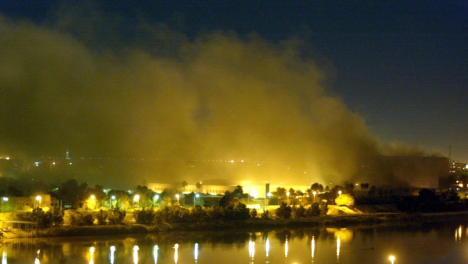
Baghdad alight and aflame on March 19th, 2003[14]
This is not to say that Iraq has not needed to expand its power generation capabilities. As these reports point out, Iraq’s population and accompanying electricity consumption is indeed set to nearly double by 2030.[15] The problem is that Iraq already has enough installed generation capacity today to meet a level of demand a decade ahead. The 81 billion dollars that has been invested in Iraq’s electrical system has driven the addition of nearly 64 billion kilowatt-hours to existing capacity since 2003.[16] As a matter of fact, Iraq’s potential energy supply has outstripped demand since as early as 2010.[17] That surplus has continued to rise, growing to nearly double demand in 2018, the same year that fiery summer protests led Basrans to torch nearly every government office in town over the lack of power and water.[18]
Parsing out the gaps between Iraq’s potential power output and its actual delivery can explain widespread black outs but exposes another peculiarity. The first gap appears between the nameplate capacity, the maximum sustainable power output under ideal conditions, and the effective capacity of watt-hours produced. In Iraq, plants operate at less than 60% of capacity.[19] The lack of appropriate fuels has been a primary driver in the inefficiency of Iraq’s turbines with engineers using crude substitutions or idling turbines due to the difficulty of obtaining natural gas or diesel. Visiting the Quds station in 2006 to understand this phenomenon, electrical engineer Glenn Zorpette discovered the following[20]:
Quds has eight combustion turbines. … Engineers have tried to set them up to burn diesel fuel, but without success. It has been several months since any of them have run.
“The basic problem with Quds is, we have four LM6000s out there that essentially don’t have a fuel supply,” says a U.S. power- generation engineer who did a yearlong tour in Iraq. “We installed a third of a billion dollars’ worth of combustion turbines that can’t be fueled.”
They work well on natural gas, but to run on diesel, they need high-quality fuel and a fair amount of operational sophistication, two things in short supply today in Iraq. “The first time I went to Quds and saw those LM6000s, the first words out of my mouth were, ‘What the hell are those things doing here?’”
It is unclear how many LM6000s were brought to Iraq only to sit and collect dust. Zorpette recalls the power-generation engineer explaining that they purchased out of a “misunderstanding.”[21] Yet, a 2010 Special Inspector General for Iraq Reconstruction report to Congress notes the awarding of a contract to GE for two additional LM6000s engines four years later.[22] To add insult to injury, these engines are often parked across from oil wells burning out the very fuel they lack. While proposals abound to captured the wasted gas, no project has made significant headway.[23]
Even after accounting for improper turbine operation, the total electricity generated would still cover demand. However, that would exclude the gap between actual production and its delivery. Typical transmission systems lose approximately 8% of their power over the long power lines and substations that connect turbines to end-users.[24] Iraqi energy analysts describe losses of around 60% in transmission. That figure is misleading as it fails to distinguish between commercial losses and technical losses. Commercial losses which comprise unbilled and unpaid billed delivery make out the 49% of all electricity use.[25] Those losses can be dismissed, given that the stated objective for the Ministry of Electricity is to generate power and not profit. That leaves technical losses at a rate of 20% of actual power generated, a relatively high but not unfathomable figure.
The third and final argument given for Iraq’s mismanaged power grid is its reliance on a single public sector entity. The most commonly cited example of corruption within the ministry is its hundreds if not thousands of “ghost employees.”[26] Yet the Ministry of Electricity, like most major cost centers in the Iraqi government, was instructed to hire Iraqis en masse to fend off the insurgency. While that might make the Ministry inefficient, it does not make them necessarily ineffective. Even during the era of Saddam Hussein, infamous for its nepotism, bribery, and an expansive bureaucracy, the ministry had witnessed well-documented success in electrification. Furthermore, it is worth pointing out that the Ministry of Electricity works primarily through public-private partnerships. Their work involves budgeting, the tender and selection of bids, issuing licenses to independent power producers, and the evaluation of present and future policies and projects. To power the grid, the Ministry contracts the private sector for nearly all its functions including finance, design and engineering to procurement and construction. For example, while the Ministry of Electricity worked out a deal with GE to provide a multi-kilowatt plant, it was GE that was most directly responsible for ordering and installing unfuelable gas combustion engines. If state-owned institutions are hopelessly corrupt, their corruption goes hand-in-hand with the corporations and firms that critics of the Iraqi government extol for their supposed profit-motivated efficacy.
The goal of this review of the present state of Iraq’s electricity system is not to determine the precise missteps that have left Iraqis without power. A lack of transparency on ongoing electricity projects places parsing out the distribution of those funds beyond the scope of this study. Instead, the purpose of this limited investigation is to complicate a narrative which locates the blame squarely on Iraqi shoulders. Evaluating Iraq’s reconstruction in aggregate reveals the uncomfortable truth: there is no shortage of power in Iraq. If Iraq’s electrical system operated today as designed, every Iraqi could go out and run an entire new set of refrigerators, televisions, and air conditioners all at the same time without a blackout. Yet Iraqis today receive a little more than 12 hours of power on a good day. With the Ministry of Electricity’s recent announcement of an additional $25 billion outlay for new infrastructure, Iraqis are rightfully wondering if it is actually the government that is robbing them.
Sources
-
Margaret Warner, “In Iraq, Electricity Remains Daily Struggle for Families, Businesses,” PBS Newshour, September 3, 2010, www.pbs.org/newshour/show/in-iraq-electricity-remains-daily-struggle-for-families-businesses ↩
-
Salam Faraj, “Iraq sizzles as blackouts hit,” AFP, July 2, 2021. ↩
-
Yesar al-Maleki, “Missing the long game: Washington’s high-risk energy diplomacy in Iraq,” Middle East Institute, March 13, 2020. https://www.mei.edu/publications/missing-long-game-washingtons-high-risk-energy-diplomacy-iraq. ↩
-
Glenn Zorpette, “Re-engineering Iraq,” IEEE Spectrum 43, no.2 (2006): 31. ↩
-
Glenn Zorpette, “Re-engineering Iraq,” IEEE Spectrum 43, no.2 (2006): 31. ↩
-
AUISofficial, “Iraq's Electricity Challenges: US Sanctions, Iran, and the Future of Energy”, American University of Iraq, Sulaimani, April 30, 2020. https://youtu.be/Iakqvx0vqy0 ↩
-
United States Department of Energy, Energy Information Administration, “2020 Average Monthly Bill Residential,” https://www.eia.gov/electricity/sales_revenue_price/pdf/table5_a.pdf ↩
-
Robin Mills and Maryam Salman, “Powering Iraq: Challenges Facing the Electricity Sectors in Iraq,” Al-Bayan Center for Planning and Studies, October 2020. ↩
-
Helen Chapin Metz, “Iraq: A Country Study,”Washington, D.C.: Federal Research Division, Library of Congress, 1990. https://www.loc.gov/item/89013940/. ↩
-
United States Department of Energy, Energy Information Administration, Iraq, https://www.eia.gov/international/data/country/IRQ ↩
-
Margaret Warner, “In Iraq, Electricity Remains Daily Struggle for Families, Businesses,” PBS Newshour, September 3, 2010, www.pbs.org/newshour/show/in-iraq-electricity-remains-daily-struggle-for-families-businesses ↩
-
T. Christian Miller, “Iraq Power Grid Shows U.S. Flaws,” LA Times, September 12, 2004. https://www.latimes.com/archives/la-xpm-2004-sep-12-fg-power12-story.html ↩
-
Japan International Cooperation Agency. Final Report, Special Assistance for Project Implementation (SAPI) for Electricity Sector Reconstruction Project. December 2017. ↩
-
Radio Free Europe, “Shock And Awe: Images Of The 2003 Invasion Of Iraq,” March 17, 2013. https://www.rferl.org/a/24928557.html ↩
-
International Energy Agency, Iraq, Data and Statistics, iea.org/data-and-statistics/data-browser?country=IRAQ ↩
-
Abbas Kadhim and Sara Vakhshouri, “Iraq’s Energy Security Strategy: A Path to Diversity and Energy Independence,” Atlantic Council, Issue Brief, December 2020. ↩
-
Frank Gunter, “Rebuilding Iraq’s Public Works Infrastructure Following the Defeat of ISIS,” Foreign Policy Research Institute, November 2018. 13. ↩
-
Jennifer Williams, “The violent protests in Iraq, explained,” Vox, September 8, 2018. ↩
-
Glenn Zorpette, “Re-engineering Iraq,” IEEE Spectrum 43, no.2 (2006): 29. ↩
-
Glenn Zorpette, “Re-engineering Iraq,” IEEE Spectrum 43, no.2 (2006): 29. ↩
-
Glenn Zorpette, “Re-engineering Iraq,” IEEE Spectrum 43, no.2 (2006): 29. ↩
-
Special Inspector General for Iraq Reconstruction, Quarterly Report and Semiannual Report to the United States Congress, July 2010. ↩
-
Alissa J. Rubin and Clifford Krauss, “Southern Iraq’s Toxic Twilight”, The New York Times, https://www.nytimes.com/2020/07/16/world/middleeast/iraq-gas-flaring-cancer-environment.html ↩
-
United States Department of Energy, Energy Information Administration, Iraq, https://www.eia.gov/international/data/country/IRQ ↩
-
CPCS, “Development of a Reform Roadmap for the Electricity Distribution Sector in Iraq,” Reform Roadmap Report Presented to the Ministry of Electricity and the World Bank, February 25, 2015. ↩
-
Glenn Zorpette, “Re-engineering Iraq,” IEEE Spectrum 43, no.2 (2006): 35. ↩